


This portfolio highlights applied research and development projects focused on creating resilient systems in environments with limited infrastructure and resources. Each project emphasizes local sourcing, modular design, and community ownership, addressing critical needs including food, energy, water, sanitation, healthcare logistics, and data management. Progress is grounded in hands-on experimentation and practical deployment, with an emphasis on replicability and sustainability.
_________________________________________________________________________________________________________________________
Structures
Working on Small-moderate sized structures made from locally available materials that address pain points such as food production, sanitation, housing among other needs.
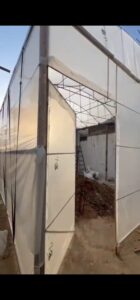
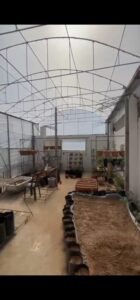
We recently designed and helped build a Greenhouse in Gaza with Veranda Design (https://verandadesign.org/) which was destroyed by rough weather which involved winds and heavy rains. It was rebuilt from rebar obtained from destroyed concrete structures, and greenhouse tarp which was available. See Pictures below, a video is coming
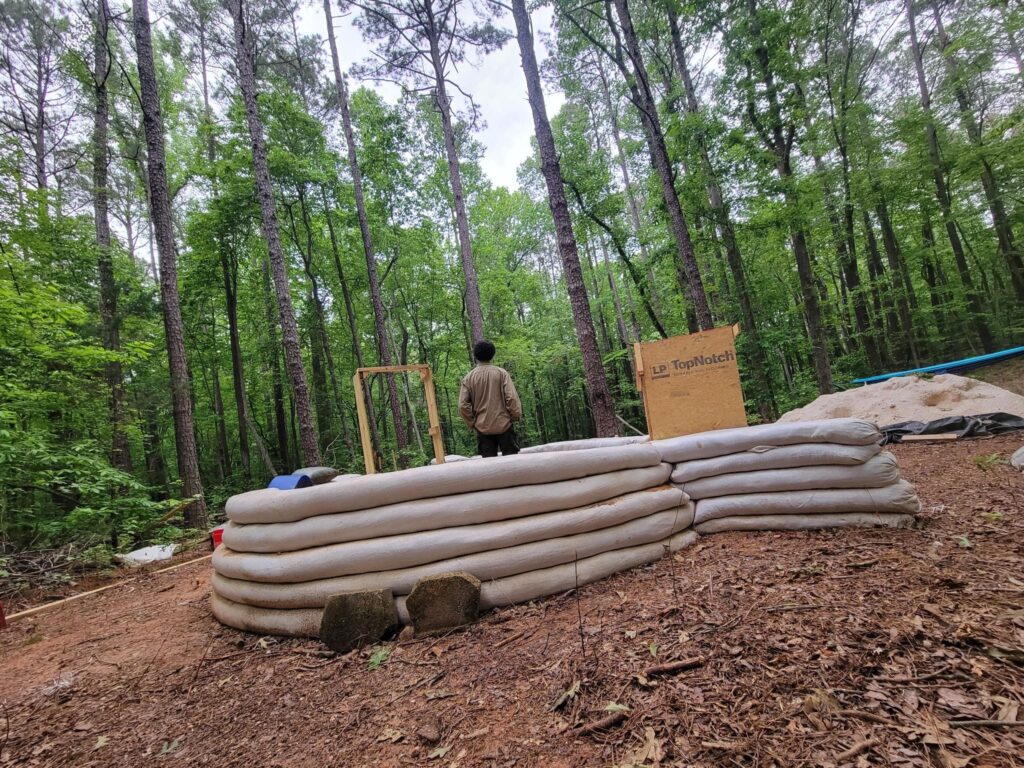
Our next project is building a small housing structure built from the SuperAdobe concept (Calearth.org), using locally available rice bags, barbed wire (yes its available), and local clay/sand/water mixture. The project will also be completed with both Veranda Design, and Al Risaleh Foundation.
Some information on the benefits of SuperAdobe structures:
https://www.latimes.com/00000195-d9d3-d1bd-a5bf-dff7621b0000-123
Our work prototyping & filming the building process for Veranda Design:
https://www.youtube.com/shorts/RzKYxClv56M
https://www.youtube.com/shorts/JOUBTLi6Uzo
https://www.youtube.com/shorts/KtXXZbkV_UY
https://www.youtube.com/shorts/crQddp1b2-o
https://www.youtube.com/shorts/uMvEs9a3smQ
https://www.youtube.com/shorts/AoulGrb-r8E
Food
Working on food systems which are easy to grow in small plots (or indoors), grow relatively fast compared to conventional methods and produce more, and can be replicated using locally available materials.
The first food project is the Egg Hatchery, a relatively small Egg Hatchery carrying ~500-750 eggs powered by a Solar Panel to keep the temperature consistent during the egg hatching process – a project collab with Veranda Designs. The Egg Hatchery will participate in the local economy in Gaza where fertilized eggs will be obtained from other entrepreneurs focused on chickens laying eggs, and after the fertilized eggs are hatched, poultry will be exchanged for more fertilized eggs.
Prototyping the Egg Hatchery:
https://www.youtube.com/shorts/IMeODVG9_V0
https://www.youtube.com/shorts/6kKj6vXKiHY
The 2nd project is attempting to make a scaled down permaculture system to produce food that can serve as an adjunct calorie source. Current food systems being tested are sweet potatoes, radishes, cucumbers, among other vegetables. Other hardy foods are also being tested to grow in indoor environments including Chaya, and the Jerusalem Artichoke. This system will be attempted to be validated locally, Nushoor has applied to 2 grants in Erie County to verify that the systems produce consistent results. We also have links with MSSN (MSA) in Nigeria who is interested in replicating both systems once complete.
https://youtube.com/shorts/tUWcYEyHAc0?si=bSyKEs8ogyHey9ny
More videos in the works
Power
Generating sustainable energy solutions for disenfranchised communities. Currently working on 3 projects
First power project is a portable power storage in conjunction with Solar powered Egg Hatchery – a storage system with different inputs from solar, mechanical (and later from wind, hydro) which will power an Egg hatchery along with other items (see “Food” for video)
https://www.youtube.com/watch?v=AoYHx0V-FFE
The second power project is a wind turbine made from waste materials – in this case a discarded motor from a washing machine. Take a look at the clip below!
https://www.youtube.com/shorts/KH_P2vkbJAQ
Our third power project focuses on optimizing pedal generator design to maximize power output while ensuring rider comfort. We are researching how to best harness human kinetic energy to provide reliable, independent power solutions.
New Videos coming soon!
The Fourth power project focuses on creating a “Solar Concentrator”, utilizing solar energy to create a focal point of high temperature – this can be used for cooking, heating a bucket of sand (“Sand Battery”) to store heat for cold nights among other uses.
Prototype being tested and built in the States, and replicated by a on-the-ground partner in Sudan
https://youtube.com/shorts/0KG_Gi3A0pM?si=wUmWujrI_ueoEFTP
https://youtube.com/shorts/4-SqAsGJC0s?si=411HQUD6vryygRqW
Sudan Solar Concentrator:
https://youtube.com/shorts/OQdpYsyTrd0?si=urVlspA4k0SUvMZw
The Solar Concentrator Project is being submitted to the IEEE GHTC (Global Humanitarian Technology Conference) on 4/29/26
Humanitarian Drone
Drones will shape the future; the question is whether they destroy or create. We intend to be part of the latter. Following UNICEF’s lead in unlocking humanitarian applications, we want to position ourselves to be part of this vital movement.
https://www.unicef.org/innovation/drones
The Humanitarian drone team hopes to create one of the first autonomous drone to deliver medical supplies – current models exist which require human pilots & navigational infrastructure, but what if you are low on both? We hope to have the answer.
https://youtube.com/shorts/tk7sFobCgOw?si=uLbHwQkNIcT7rgUl
New Videos coming soon!
Decentralized Servers/EMR
In many underserved communities, the burden of record-keeping falls on the patient, leading to lost histories and fragmented care. The alternative is relying on an unstable internet for expensive centralized systems to store health data. We want to create an alternative with a decentralized, low-cost EMR. Our system keeps health data secure and local, ensuring that even in areas without a stable internet, a patient’s medical information can be securely stored and retrieved.
We hope to implement this with our partner NGO in the Rohingya Refugee camps in Cox Bazaar, Bangladesh.
3 Emerging Teams
Medical Tools/3D Printing
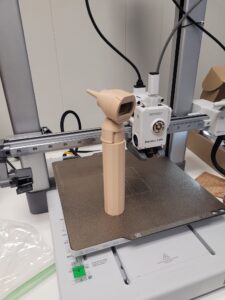
Partnering with Basmah (Basmah.org) and Rohingya refugees, this team’s focus is to identify critical healthcare pain points within the Rohingya refugee community in Cox’s Bazar, and then to design medical tools from the local region to address those pain points. This coming week we will be on a call with a Rohingya refugee in Cox Bazaar, and the week after we will virtually meeting Basmah Medical Staff to start this process.
Along with focusing on project implementation, the project will also be submitted here:
https://cbid.bme.jhu.edu/news-events/design-competition/
Current Ideas being explored –
Water safety: Camps suffer from unclean water with very high contamination rates. Exploring a UV based method to eliminate bacteria and viruses from water, while considering practicality and feasibility in camps.
Mosquito control: Malaria and dengue have severely affected camps, leading to a high number of cases. Since mosquitos are attracted to standing water to lay eggs, we are researching simple water based traps that draw them in but prevent them from escaping.
Foot injury prevention: Many individuals suffer cuts due to improper footwear, and rough terrain. This increases the risk of foot injury. The med team proposed a gel-like solution to act as a cushion to decrease foot injury but also improve daily function.
Water
Unfortunately Western New York is cold for half the year, making it difficult to explore both water purification methods, and hydropower. Fortunately we have 3 university students in the Malaysian branch of MONASH (https://www.monash.edu/) who are trying to take charge. The 3 students are part of a non-profit called Voice Of Good (VOG), and ran an “ideathon” trying to recruit students interested in the topic. We are in the process of integrating this project as a pilot project in the NGO, along with connected with another NGO named Light Of Borneo (https://www.youtube.com/watch?v=TY9c32wSRBQ) to work with them to install microhydro systems to disenfranchised communities in south east asia.
Communication
Cell phones, GPS, the Internet – the invisible backbone of modern life; but for disenfranchised communities, that backbone is often missing. Our team works to ensure that the ability to communicate securely, a vital pillar of any economy and society, is accessible to everyone. We hope to explore the full legal scope in any situation; whether we are utilizing satellite links, experimenting with DIY antenna configurations, or repurposing basic sensors for long-range use, the goal is to create durable communication platforms.
Research Leaders in training: AbdulHadi, Usman
Movement & Non-Profit Management
Running an organization and starting a Movement is not easy. From figuring out funding structures, recruitment, project management & implementation, media work, not to mention navigating the many government laws in place, cultivating relationships with many different organizations…
Requires an agile and dedicated team – and we are training people to be experienced in these roles.
Interested in making a difference? Sign up as a volunteer!
Any questions can be sent to info@nushoor.org