


Each project is assigned a Phase from I to IV to track its ongoing progress
Phase I: Context research and ideation of solutions with the partner community
Phase II: Prototyping and solutions
Phase III: Technology Transfer and Implementation
Phase IV: Monitoring
Structures
SuperAdobe; Phase III: We are currently building the first SuperAdobe structure in Gaza in partnership with Veranda Design (https://verandadesign.org/). This structure introduces a new building approach to the Gaza region, which we aim to prove viable for its constrained circumstances.
Our fundraising is officially complete (Thank you to Hidden Humanity for Crowdfunding support!), and we have broken ground this week! We expect to finish construction by the end of summer 2026.
Following completion, we plan to co-submit a research paper with Veranda Design to the International Conference on Resilient Engineering (https://engconf.iugaza.edu.ps/ ). Looking ahead, Part II of the project involves building multiple units as a self-sustaining village in coordination with larger partner organizations.
The SuperAdobe concept was originally developed by architect Nader Khalili and his organization, CalEarth (CalEarth.org). This building method has proven its durability in different global contexts, ranging from Latin America to Pakistan, although it does particularly well in dry, arid climates.
Some information on the benefits of SuperAdobe structures:
CalEarth.org
https://www.bbc.com/future/article/20190228-what-is-superadobe
https://www.latimes.com/lifestyle/story/2025-02-20/superadobe-calearth-hesperia-fire-resistant-los-angeles
https://www.latimes.com/00000195-d9d3-d1bd-a5bf-dff7621b0000-123
Technical videos filmed & edited for the partner community:
Greenhouse, Phase IV: In our last project, we designed and built a Greenhouse in Gaza with Veranda Design, using rebar obtained from destroyed concrete structures and Greenhouse tarp available in the local economy. Veranda is now growing vegetable plants to be distributed to the local neighborhood.
Take a look!
Food
Composting, Phase II: Our partners on the ground noted ongoing efforts to create an effective composting system in Ga__, as rich soil forms the foundation of most agriculture there. Unfortunately, these attempts have failed so far due to a decrease in the volume of available organic waste. Veranda is researching methods to supplement organic waste with cardboard and waste paper. To assist, Nushoor is investigating DIY methods to accelerate the breakdown of cardboard and paper, using alternative composting methods such as Bokashi and JADAM.
We are currently running four parallel experiments- comparing Bokashi, JADAM, traditional composting, and using chicken droppings as plant feed – and reporting the data back to Veranda.The composting project is taking priority over other permaculture systems, which continue to be investigated.
Power
Focus is on generating energy solutions for disenfranchised communities, and using the electricity already available more effectively.
Solar Powered Egg-Hatchery project, Phase II; is to be implemented after the SuperAdobe project Phase 1 is complete by late Summer 2026. In coordination with Veranda, the prototype being designed will feature a Solar panel system, with a fusebox for safety, connected to a Lithium ion battery(s?), and an inverter to both charge electronics and power the incandescent bulbs and fan needed by the Egg Hatchery.
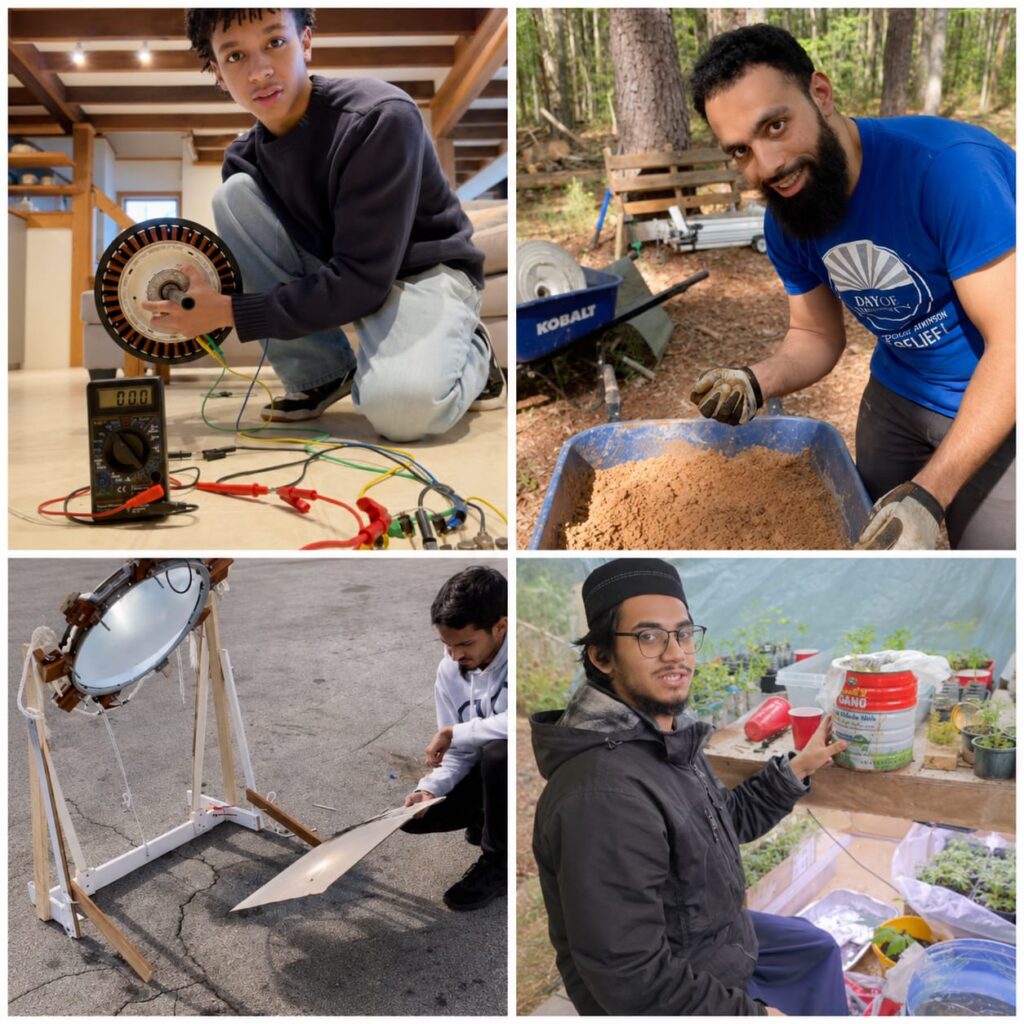
Wind turbine made from E-Waste; Phase II; and is now in its testing phase. After evaluation of Wind patterns, it was determined this project would be best suited for Port Sudan, due to high winds from the Red sea. A 63 foot tall wind turbine has been built by the UNDP in the area: https://www.undp.org/arab-states/press-releases/sudans-first-wind-turbine-arrives ; https://www.downtoearth.org.in/africa/renewable-africa-turbine-for-first-sudanese-wind-plant-arrives-from-the-netherlands-77541
However, further expansion for the project has been derailed due to the war. Nushoor’s idea is to turn readily available E-Waste available in many African countries (https://pmc.ncbi.nlm.nih.gov/articles/PMC8392572/), including Sudan, and repurpose it into smaller Wind turbines. We are exploring collaborations with another organization for implementation.
Optimizing pedal generator design, Phase II; to maximize power output while ensuring rider comfort. We have found that an Electric bike provides much more consistent power, we plan to explore optimal gear ratios, lubricating the bike, and connecting the bike to a battery system vs direct power without a battery system.
Medical Tools/Water Purification
UV Light Water Purification System, Phase II; A four-person team is designing a sustainable water purification system for Rohingya refugees in Bangladesh by combining UV filtration, heavy metal removal, and testing natural Moringa seeds. They developed this solution using research from camp interviews, two non-profits, and guidance from Dr. Abul Husam of George Mason University, with help from the Rohingya Empowerment Community (REC), and plan to enter it into the CBID Design Competition (https://cbid.bme.jhu.edu/news-events/design-competition/ )
Solar Powered RO System, Phase I; Meanwhile, Nushoor’s new Malaysia chapter is launching its first project to pair a small reverse osmosis system with solar power to replace an unstable local electrical grid that only works half the day. We hope to be partnering with SAFIR (Sudanese Academic Forum for Institutional Reform)
Humanitarian Drone
Humanitarian Autonomous Drone, Phase II; Drones will shape the future; the question is whether they destroy or create. We intend to be part of the latter. Following UNICEF’s lead in unlocking humanitarian applications, we want to position ourselves to be part of this vital movement.
https://www.unicef.org/innovation/drones
This is a complex project, requiring additional motivated Research-Interns who have strong interest in Robotics and computer science – we have 2 mentors for both hardware and software to help guide new Research-Interns. If interested, please email info@nushoor.org
The Humanitarian drone team hopes to create one of the first autonomous drone to deliver medical supplies – current models exist which require human pilots & navigational infrastructure, but what if you are low on both? We hope to have the answer.